
Tony Geering at the Bröhan Museum
A Lifetime with E. W. Godwin
A speech reflecting on Edward William Godwin, Oscar Wilde, the Aesthetic Movement and a lifetime spent collecting Godwin’s furniture and design legacy.
Bröhan Museum, Berlin · Full speech transcript · Film coming soon
Introduction: A Lifetime of Collecting Godwin
My thoughts and ponderations: a lifetime of collecting the works of Edward William Godwin, to me the most important architect-designer of late 19th-century England, who laid the foundation stones for not just modern architecture but modern furniture design, which we now see as works of art fused with an economic and sanitary approach. His influence resonated around the world and still resonates clearly to those who care to know about him and understand his vision, as I do. He was a demi-god of design of his time, who, when he died in 1886, was almost lost to obscurity, except that he left us a design code that refused to fade into oblivion. The simple sophistication of his ground-breaking architecture, furniture and stage design lingered on in ever-decreasing circles up until the end of the 19th century, mainly due to the seedy dark corners of the other side of the Aesthetic Movement. It wasn't until he was re-evaluated in the 20th century that he was elevated back to the pole position he had held when he was alive. In November 1900, Max Beerbohm specifically described Edward William Godwin as "the greatest Aesthete of them all".
The more I came to understand Godwin as a designer, the more I wanted to know about him and his personal life. That interest eventually brought me to Godwin as a critic, and it was here, reading through the lines of his narrative, that I had that lightbulb moment and realised it was Godwin the critic who was the main influencer of design in his day. His critique is written in blood in the journals of his time that are the history books of today. His historical critical eye saw through those architects with no sense of design; he held them with contempt and was not afraid to write in the journals of his time about them. He happily hung them out to dry with a ferocious distaste for what he called farmyard architects, who are but surveyors to the wealthy patrons who dictate the atrocities they call style.
Within today's world of design, there is not much the steady hand of Godwin hasn't touched. When we look at what he created from his own mind and how that developed over time into one of the most creative minds of his period, encapsulating architecture, furniture design and interior design, the three skills he excelled in. Godwin lived the life of Art for Art's Sake and, in many ways, has come to define art and design in a time where there was no constraint, no curriculum, no standard for building buildings and no planning act to prevent bad architecture whatsoever. As a matter of fact, buildings were mostly designed by businessmen, speculators and, his most irritating of all, the slam copyist mixing a myriad of styles to make a misfit of what they called architecture.
The 1851 Crystal Palace exhibition was not the success we read about but mostly a display of cheap, mass-produced, badly designed wares and fancy goods that did not uphold the values of what art and design together could create; if anything, they were separated at conception. Henry Cole, Richard Redgrave, Owen Jones and Prince Albert started the design reform movement, which was to reshape British design forevermore, and here Godwin took the baton and ran with it far into the future. There is a certain perfection in so much of what he created, created from his study of architecture and furniture design from the Greeks to the Egyptians and then his journey into the cult of Japan. Godwin was a visionary in the true meaning of it; he saw more clearly than any other architect of his time, including most of the architects who followed throughout the 20th century, and many of the so-called architects of the 21st century who might never see the true meaning of architecture, and thus will never grasp that all architecture should be considered as art. Godwin sharpened his skills throughout his life by drawing architectural objects, studying past styles and fastidiously measuring and logging ancient buildings. Without a smart computer phone or a laser level, armed only with a 12-inch ruler, a yardstick, a tape measure and a pencil, is where Godwin ruled the ruler in feet and inches. He saw in a three-dimensional way that allowed him to visualise the rooms inside the buildings that he built long before his pencil needed sharpening. In his architectural plans, he drew people, furniture and decorations. In the book Art Furniture, 1877, published by William Watt, Godwin's furniture drawings are laid out in room sets. Godwin could see through the walls of his designs; he visualised the furniture within the rooms and he connected the human to the space within. He could see in his mind's eye what the interior outcome would be; he instinctively knew what was right.
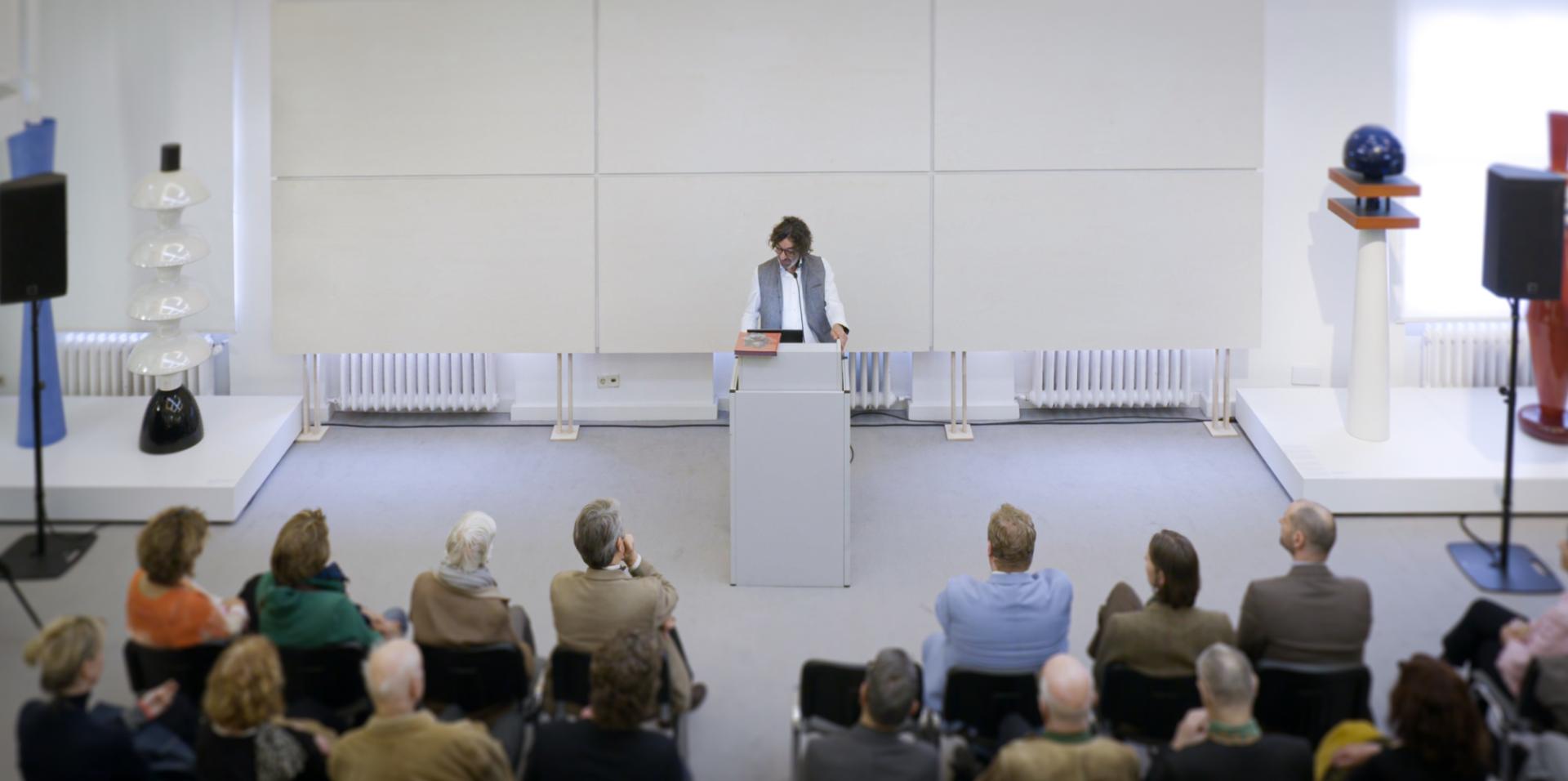
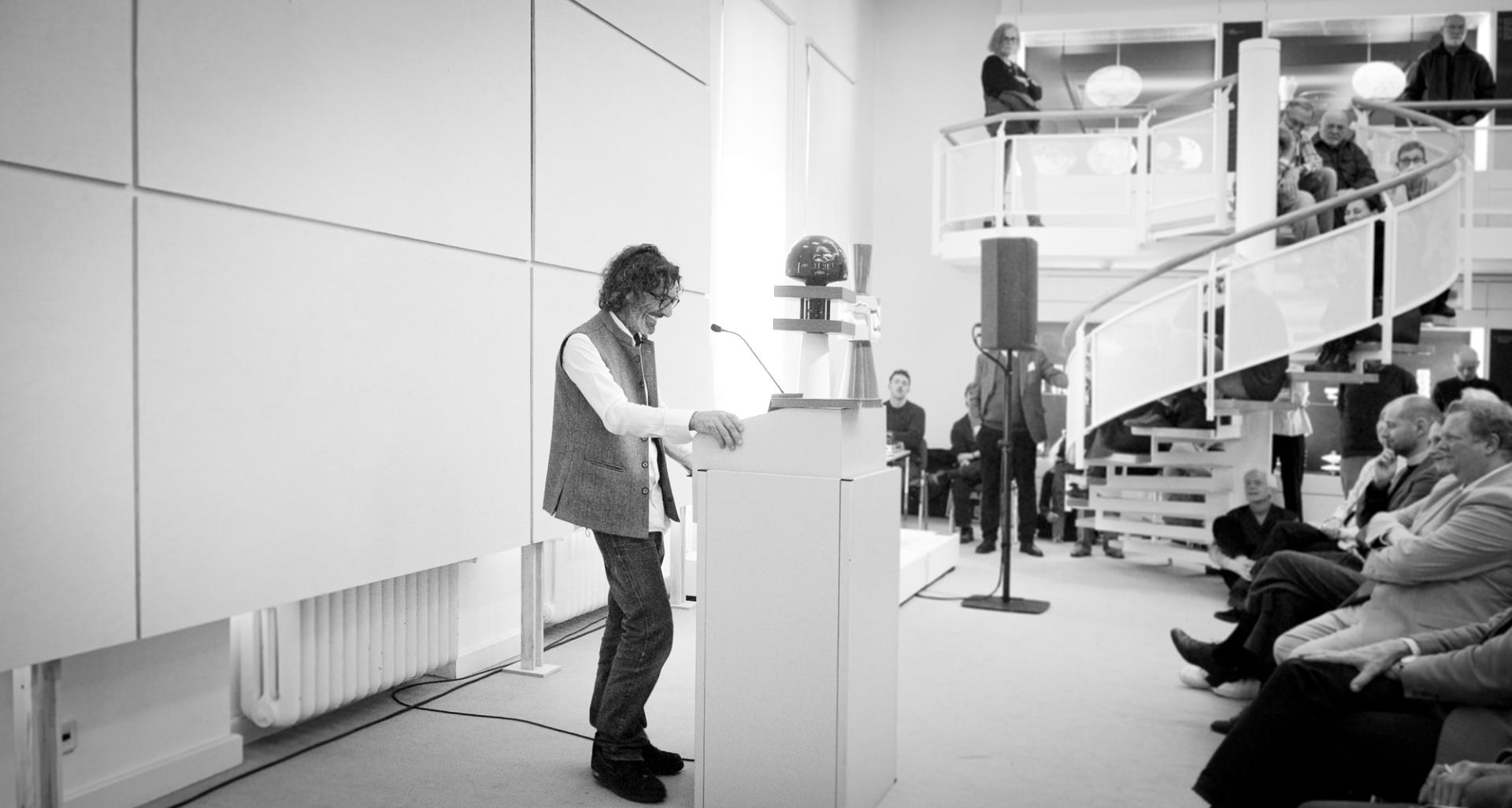
His personal life reveals he was a bad businessman, a dandy with an eye for the ladies and a rebel, a man not afraid to speak out or stick his fingers up to the establishment, a personality that appealed to me in so many different ways. It was the spirit of the man that I wanted to know more about, and there I began a lifelong journey searching for his art furniture and all things relating to E. W. Godwin. I studied his design world and stood in front of his originals in museums around the world; I stood in awe. Over forty years, coveting his works, my collection grew into the Godwin-Wilde Exhibition on display at the Bröhan Museum, with the fitting title: Decadence, Dandies and Modernism. Tobias Hoffmann, the museum director, two days before the opening, asked if I would do a speech on the opening night. I hesitantly said yes, and that evening began to write down some notes, and over the next two days, while setting up the exhibition, I stole an hour here and there and began to write the speech. I was still jotting notes down ten minutes before it opened. The room was packed; I steadied my nerves where I stood and spoke to a 300+ strong audience, the largest gathering of people I have ever had the privilege to speak to. Everyone there had come to find out about the relationship between Godwin and Wilde, with a hint of Whistler's flute to boot. Tobias invited me up to the podium, and with a scruffy start, my wings slowly opened and there was no stopping me.
Tony Geering’s Bröhan Museum Speech
The Bröhan Museum Exhibition
I arrived at the Bröhan Museum because of a great friendship that began seven years ago when Tobias Hoffmann, the director, and Fabian Reifferscheidt, curator, came on a scouting mission to London. They came in search of objects for an exhibition they were putting together called From Arts and Crafts to the Bauhaus: Art and Design – A New Unity!
Tobias purchased a number of items for the Bröhan's permanent collection from me, and with his silver tongue persuaded me to loan a number of objects for that exhibition. On a very cold January evening, on the opening night of that exhibition, Tobias introduced me to Dr. Klaus Lederer, the Mayor of Berlin, and we discussed the possibility of putting together an exhibition dedicated to E. W. Godwin. From that small seed, planted over seven years ago, I find myself standing here with you all, sharing my collection of Godwin's iconic works of art. When I first walked into the exhibition, I cried deep inside at the beauty of it all and how the Bröhan team has arranged this setting, elevating my collection to a place I have never seen before.
Godwin, Wilde and the Aesthetic Movement
Fabian and Theresa had the lightbulb moment idea to include one of Godwin's greatest friends, Oscar Wilde; to me, it was like pulling out the joker as the last card was played. To combine the social circles of Godwin, Wilde and Whistler was a masterstroke, bringing a stronger understanding to exactly what the Aesthetic Movement stood for. Aestheticism was not just a style or a period; it was a way of life, from the interior of the House Beautiful, to the way you dressed, the way you walked, and the way you talked, poetically and always ready for witty remarks. Dandies were the Aesthetes; decadence was their freedom from conformity and their reaction to the stuffy old decaying establishments of the past. The Dandies were the practitioners and preachers of Art for Art's Sake and that everything is beautiful.
Wilde's gifts were his words and his quick wit, but he was an effeminate, soft, gentle man, a man the most beautiful women of his time flocked to and wanted to be associated with, and here is where Godwin and Wilde were the same. Godwin, Wilde and Whistler attracted and associated themselves with the liberated, educated, talented women of the day; in a time when women were still fighting for their right to vote, they saw the liberated women as equals.
Godwin eloped with Ellen Terry, the most famous stage actress of the day, who was still married to the artist George Frederick Watts. For six years, they lived a peaceful, rural, artistic life, having two children out of wedlock, a scandalous love affair in the middle classes of late Victorian England. Ellen affectionately called her lover "The Wicked Earl", and for good reason...
Godwin, 1836–1886.
Godwin and the Roots of Modern Design
It was the architect and critic Hermann Muthesius who made an important connection between this generation of British architect-designers and the quest for a modern industrial design culture in early 20th-century Germany. Like Pevsner, Muthesius wrote only a few lines about Godwin’s furniture designs, which he had seen in the William Watt catalogue of 1877.
Muthesius wrote of the lightness and elegance of his furniture; he saw it as containing the seeds of the innovative designs made in Europe in the last decade of the 19th century and the first of the 20th. (Das Englische Haus, Berlin, 1904). Muthesius saw in Godwin a reaction against the more elaborate sinuous lines in Jugendstil, stating his designs were “responsive to rational progress,” showing “a great advance” in their lightness and elegance, and foreshadowing “the idea of the modern interpretation which was soon to follow.”
In 1949, Harbron wrote The Conscious Stone: The Life of Edward William Godwin, describing Godwin as a "pioneer" of the Aesthetic Movement who excelled in architecture, interior and furniture design, and theatrical productions.
The "House Beautiful": Harbron details Godwin's collaborations with Oscar Wilde and James McNeill Whistler.
In 1952, the Victoria and Albert Museum put on an exhibition displaying, for the first time in history, an iconic Godwin sideboard. This was the reawakening of Godwin from a long dormant sleep.
In 1994, he was singled out as the “unrivalled forefather” of the Modern movement. Today, Godwin is seen more than ever before as a proto-Modernist, and the iconic sideboard series was described as “perhaps the most influential furniture design executed in Great Britain during the 19th century” and “the earliest Modern Movement icon ever designed.”
Godwin foretold modernism long before the bulges and excesses of the Victorian period had receded; Godwin had teleported into the future. The themes of health, rationality, economy, utility and simplicity recur frequently in Godwin’s work.
Finding the Godwin Table
It was quite early on, in my late twenties, that I came across a small book written by Elizabeth Aslin on E. W. Godwin, which instantly fascinated me. His furniture designs were so ahead of his time, standing quietly alone in a time when Godwin was still relatively unknown. Over a short time, I came to believe that Godwin was not just a Victorian designer but somebody historically very important, a forward-thinking revolutionary designer so ahead of his day. As an engineer myself, I could see the precision and function in his designs, and in search of more Godwin information I visited the Museum of Modern Art, NY, to see the iconic side table they had in their collection. In my early thirties, I stumbled across an antique shop on the south coast of England. Dressed in faded jeans with long, untidy hair, I opened the door and a bell rang as I stepped inside. The owner, a man in his eighties, was sat at his desk, and before I had shut the door he had leapt out of his chair and was stood in front of me.
“Can I help you, young man?” I replied, “Is it OK to have a look around?”
He replied, “I suppose so,” and proceeded to follow me around his shop while breathing down my neck. I walked a number of steps and, to my disbelief, I was looking at an iconic side table designed by Edward William Godwin. I leaned down to read the description on the price tag, assuming it would say, not for sale, but to my amazement it stated, “An unusual Edwardian side table, circa 1910. £750.”
I asked, “Can I look underneath?”
He challenged me with, “Why?”
I said, “Because I would like to buy it.”
He immediately retorted in a condescending way, “That table is £750, young man.”
I said, “Yes, you just watched me read the price tag.”
“Hmm, and how would Sir like to pay?”
I replied, “With cash.”
His tone immediately changed and he turned the table onto its side, and there was what I was hoping to find, a full-length piano hinge on each of the three side flaps. I paid him, and he replied, “You are the last person I would have thought would have come into my shop and bought this table, young man.”
I replied, “Well, there you go, one should never judge a book by its cover.”
He muttered, “My name is Hubert. Do accept my apology.”
I replied, “Of course your name is Hubert; my name is Tony.”
“Touché,” he replied.
I left with what was the third known example of this modernist iconic table under my arm and Godwin in my sights forevermore. Even that old-school dealer was 40 years late with his assumption of when that table was made.
Oscar Wilde and the House Beautiful
Wilde was a dandy from the moment he was born. His mother, Jane Wilde, was a poet and highly intelligent woman of her era; by the age of eighteen, she could speak 10 languages, and Oscar was showered with her love, and she never stopped educating Oscar throughout his childhood. His father, Sir William Wilde, was the leading ear and eye specialist of his time. Jane and Sir William were known for throwing wild parties the high society would flock to, and it is here, as a young boy growing into a young man, Oscar's education into dandyism flowered amongst lavish parties in high circles; he coined his wit.
Oscar Wilde is one of the most celebrated alumni of Trinity College Dublin, Ireland. He excelled as a classicist, ranking first in his class and winning the Berkeley Gold Medal in Greek. He gained further academic honours and won a scholarship worth £95 a year for four years, leaving Ireland to study at Magdalen College, Oxford. Wilde, the man of words, a man with the gift of a retentive memory that powered his sparkling intellect and, above all, his dazzling wit. From Oxford, he was set for fame and fortune, although fortune never shone for long on Oscar.
The Aesthetic Architect Edward William Godwin meets the Aesthetic Apostle Oscar Wilde. It was Godwin who taught Wilde a vision of the modern artistic home, and it was Godwin who paved the way to The House Beautiful. Wilde’s correspondence indicates that he gave Godwin a free hand. For Wilde, his home was the moment to turn his preaching into reality, and Wilde's white interiors without Godwin would never have been realised. Godwin’s philosophy of art and decoration was obvious in Wilde’s lectures in England and across America; it is plain to see Godwin was a mentor to the young Aesthete and someone Wilde looked up to. When Wilde set up home with his newly wedded wife, Constance, in Tite Street, Chelsea, he went first to James McNeill Whistler and asked if he could help him design the House Beautiful. Whistler replied, “No, Oscar, you have been lecturing to us about the House Beautiful; now is your chance to show us one.” Wilde then turned to Godwin, and it is here, in this moment, that Godwin and Wilde began to design the white interiors and what came to be called the white cube. The interior was not significantly different from decorative schemes that Godwin had already created for James McNeill Whistler, or Frank Miles in Tite Street, or for his own house. However, the reputation and social position of Oscar Wilde raised the stakes for this commission. The Wildes' white dining room was highly unusual for its day, where Godwin also specified white furniture.
Wilde's Dining Room: described as a "Symphony in White," the room featured white walls, white-painted furniture and gold accents. It was inspired by the paintings of their mutual friend, James McNeill Whistler.
Wilde wrote in the spring of 1885, “I enclose a cheque for the furniture: each chair is a sonnet of ivory, and the table is a masterpiece in pearl.” But when he actually began to live with it, he wrote to Godwin affectionately: “Dear Godwino, . . . Of course we miss you, but the white furniture reminds us of you daily, and we find that a rose leaf can be laid on the ivory table without scratching it — at least a white one can. That is something.”
Nothing Is True But Beauty
NOTHING IS TRUE BUT BEAUTY. Oscar Wilde.
Without John Ruskin, William Morris, Whistler or Godwin, there would be no Wilde lectures on the House Beautiful. He plagiarised the words of those critics and great interior designers, coughing up the already written words of Ruskin, Morris, Whistler and Godwin, taking those solid writings written by those true experts in their fields, copying almost word for word the design regime of those who came before, those who laid the foundation of what Art for Art's Sake should be. William Morris wrote: “Have nothing in your home that, at first, you do not believe to be beautiful or useful.” During Wilde's 1882 North American lecture tour on “The House Beautiful”, Wilde mimicked, “Have nothing in your house which is not useful or beautiful.” Wilde told his audiences to tear down their heavy drapes, throw out dark wallpapers, and adopt clean, monochromatic walls while preaching against bulky, floor-hugging furniture. He effectively took Godwin’s architectural minimalism and made it his own. We might say Wilde was the charismatic frontman for Godwin's quiet genius. While Godwin revolutionised designs in his sketchbook, Wilde used his unmatched wit to bring those exact ideas to the people. Even in the world of attire, Wilde went on to edit The Woman’s World magazine, pushing Godwin’s exact concepts regarding loose, artistic and structurally sensible clothing.
In works like The Stones of Venice and Modern Painters, Ruskin launched a savage war against the Industrial Revolution. He famously described how modern manufacturing had turned cities into ash-heaps and stripped workers of their humanity. Wilde’s appropriation: during his American tour, Wilde echoed Ruskin almost verbatim, scathing modern urban sprawl and capitalist factory culture. Wilde told audiences that the ugliness of modern cities crushed the human spirit, lifting Ruskin’s romantic, anti-modern critiques directly into his lectures.
In Oscar's defence, he was a disciple of his Oxford mentor John Ruskin, including William Morris and particularly Godwin. Wilde's ability to retain information must be brought into the frame here. He borrowed and appropriated their philosophies as a follower, but where he was rather unscrupulous was that he gave no attribution to those borrowed and reshaped words. Another Oxford mentor to Wilde was Walter Pater, a reclusive Oxford academic who wrote The Renaissance, suggesting that personal pleasure and aesthetic ecstasy were more important than traditional Christian morality, causing a Victorian scandal. Pater wanted his ideas whispered quietly in the courtyards of Oxford; Wilde bellowed them from his podium, exposing Pater's private philosophy to the world, and once quoted, "Dear Pater was always frightened of my propaganda." Wilde’s blatant use of Pater’s decadent philosophies in his book The Picture of Dorian Gray backfired spectacularly when he foolishly sued the Marquess of Queensberry for libel in 1895, which became the complete downfall of Oscar Wilde, and subsequently, he was imprisoned for two years, serving the last 18 months in Reading Gaol.
Godwin’s Influence on the Future
E. W. Godwin, the Master of the Modern Movement, was a polymath: architect, engineer, interior decorator, furniture designer, theatre designer, writer, teacher and critic, who went on to be the most influential designer for the next generation of architect-designers, particularly C. R. Ashbee, C. R. Mackintosh and C. F. A. Voysey. Voysey praised Godwin's work; he said, "What did Godwin do for furniture? He cut off its tails." Mackintosh studied in his own true style with a strong Japanese influence because of Godwin's lead. Godwin had said, when asked what style you design in, say your own style. Mackintosh said: "You must be independent, independent, independent — don't talk so much but do more. Go your own way and let your neighbour go his. Shake off all the props tradition and authority offer you, and go on alone. The artist's motto should be, 'I care not the least for theories or for this or that dogma so far as the practice of art is concerned — but take my stand on what I consider my personal ideal.'"
If there was one designer in the late Victorian period who shaped the forward-thinking architects and designers of the future, not just the next generation but all generations who have followed, it is one man, that Master of the Modern Movement, “The Wonderful Wicked Earl.”
Thanks to the Bröhan Museum
If I may, I would like to thank everyone at the Bröhan, whom I have affectionately named the Brohanians, for making me feel at home here and a part of the Bröhan family. What they do behind the scenes is admirable; the relentless time and research, and the search for knowledge for the rare and original, is no nursery lesson. It is the magic of bringing the designers, artists and makers back to life, telling their story through history and displaying the objects that these gifted creators created through their lifetimes, and then threading it all together to teach us of the reality of it.
Who: who the designers were. What: what did the designers design? Why: why did they design it in that way, and why did a style evolve in such a way? When: when did they design it, and what was happening in the world and in current affairs in that moment that led these gifted designers to create those master creations? But the Brohanians go further and deeper to reveal the inner personalities of these creators; they delve deep into their private lives, revealing their friends and families, associates and patrons, bringing back to life the colour and the music of their lives so we can understand the who, the what, the why, the when and where these gifted creators created, and the reaction that followed.
Everybody who works behind the scenes at the Bröhan is passionate about the arts; they are here because they first want to be. The search for knowledge is addictive and the research is their antidote. I have always said if you find what you love in life, you have found the meaning to it, and like the artists who each in their undivided individual ways found their meaning to their lives, in many cases through symbolism, through the want for change, or to enter into modernism, and to be a part and apart, the young will one day inherit the world. As the old ways are pushed back into the depths of the past, so come the new imaginations that give each new generation their identity. At the Bröhan, they do just that: they bring back to life those designers and artists of importance, those liberators of design who were the young designers of their past. You see, we are the passionate grave-diggers of the past; we are addicted to the thirst for knowledge to understand what has gone before that still resonates in the now and, in many cases like Godwin and Wilde, still resonates into the future.
My final thank you of this evening is to my young, passionate team Jake, Ty and Danny, and my sons, who have always believed in me and my work, who on occasion, when I fall asleep in my chair with a book, turn off the light that I burn deep into the night.