-medium-size.jpg)


-thumb.jpg)


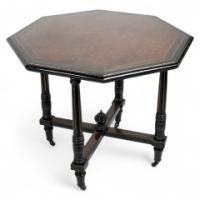
Charles Bevan for Marsh & Jones – Gothic Revival Burr Walnut Sutherland Table.
Price on Application
This item is price on application due to its rarity and importance.
Width: 37.8 in (96 cm)
Depth: 9.84 in (25 cm)
1860-1869
About this piece
By Charles Bevan for Marsh & Jones, a burr walnut Sutherland table aligned to the Gothic Revival (1860–1869), c.1860s.
Drop-leaf Sutherland form with a very narrow fixed centre and two hinged leaves. The top is faced in richly figured burr walnut, framed by a continuous perimeter band of fine marquetry with chequer motifs and small roundels at intervals. Corners are softly rounded and the edge is neatly moulded.
End standards are shaped and splayed, each raised on brass cup castors with small timber wheels. The outer legs swing to support the leaves when opened. A paired central trestle carries a turned stretcher between uprights, keeping the underframe open and light yet providing a generous surface when raised.
Legs move from octagonal facets into turned rings and collars. Blocks are crisply shouldered with shallow scoops. Pegged construction is expressed as small round pellets to the faces of the legs and rails.
Retains the original Marsh & Jones paper label. Designer recorded as Charles Bevan; maker recorded as Marsh, Jones & Cribb in later company style; period and style recorded as Gothic Revival. Condition noted as good.
Context: Bevan’s collaboration with Marsh & Jones, later Marsh, Jones & Cribb of Leeds, produced notable Gothic and reformed-Gothic designs, including work for Sir Titus Salt and Titus Salt Jr. Suites from these commissions, including a mediaeval-style bedroom suite and a marquetry grand piano, are preserved in Leeds City Art Galleries, Temple Newsam House. By 1867 Bevan was no longer associated with the firm; he also worked with Gillows, Holland & Son, and J. P. Seddon.